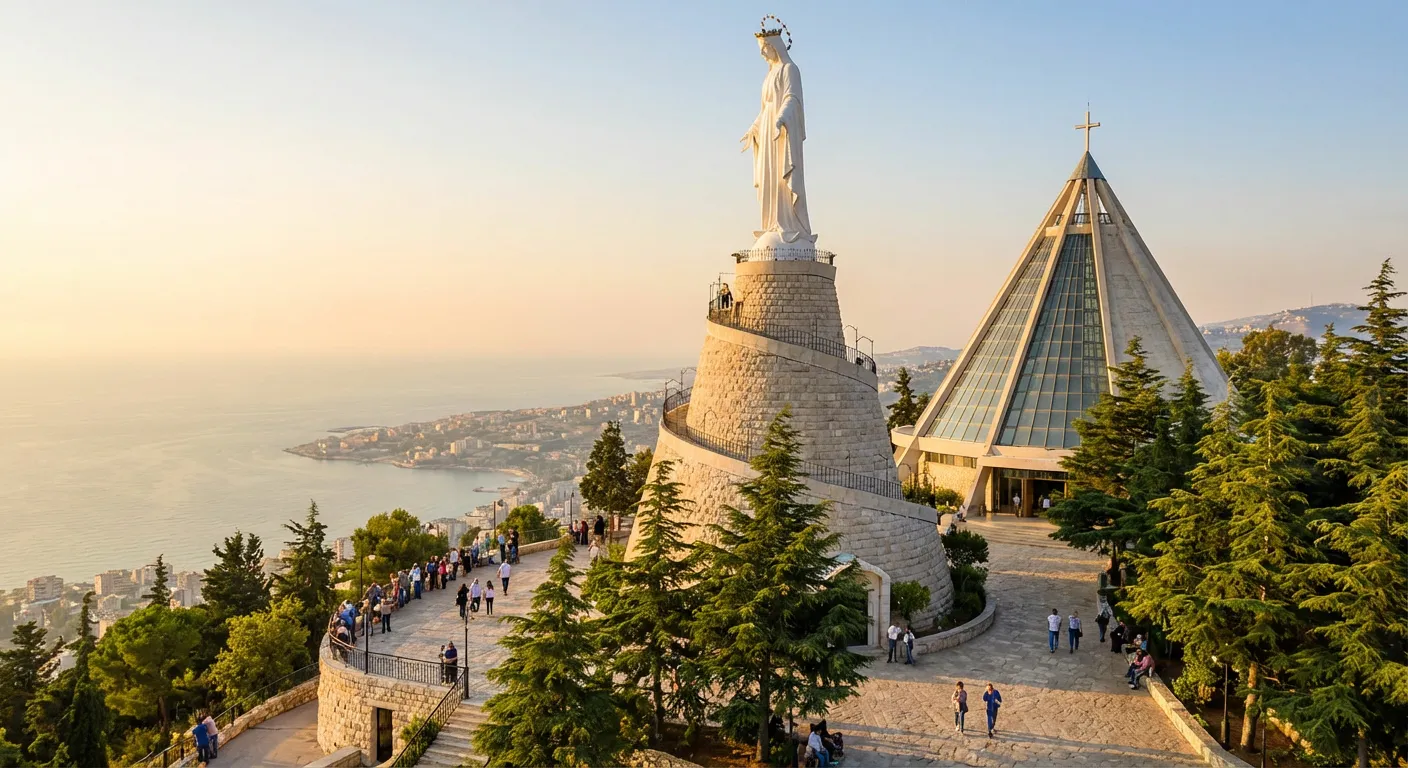
Our Lady of Harissa
It is important to clarify that Our Lady of Harissa (widely known as Our Lady of Lebanon) is not a traditional Marian apparition site. Unlike locations where the Virgin Mary is reported to have appeared and spoken to specific individuals, there were no direct visions, spoken messages, or individual visionaries recorded here in 1904. Instead, this monumental Maronite Shrine was born out of the profound, collective devotion of the Maronite community. It was established by the Maronite Patriarch to commemorate the 50th anniversary of the Catholic dogma of the Immaculate Conception, serving as a massive expression of faith rather than the result of a singular supernatural event.
While there are no accounts of Mary speaking or appearing to visionaries, the faithful often describe the enduring peace and spiritual atmosphere at Harissa as a miracle in itself. The shrine is crowned by a magnificent, towering bronze statue of the Virgin Mary, painted white, with her arms outstretched toward the capital city of Beirut and the Mediterranean Sea. For over a century, pilgrims have traveled to this mountaintop sanctuary seeking Mary’s intercession. Many who visit report experiencing profound personal graces, spiritual healings, and a deep sense of divine comfort under her protective gaze.
The lasting impact of Our Lady of Harissa on the faithful is immeasurable. As a major Maronite Shrine, it has transcended denominational lines, becoming a powerful symbol of unity, protection, and peace for all of Lebanon. It draws millions of visitors annually—including both Christians and Muslims, who also hold a deep reverence for Mary. Even without a founding apparition, the shrine stands as a beacon of hope in the Middle East, standing as a permanent testament to a community's unwavering love and devotion to the Virgin Mary.
2000000