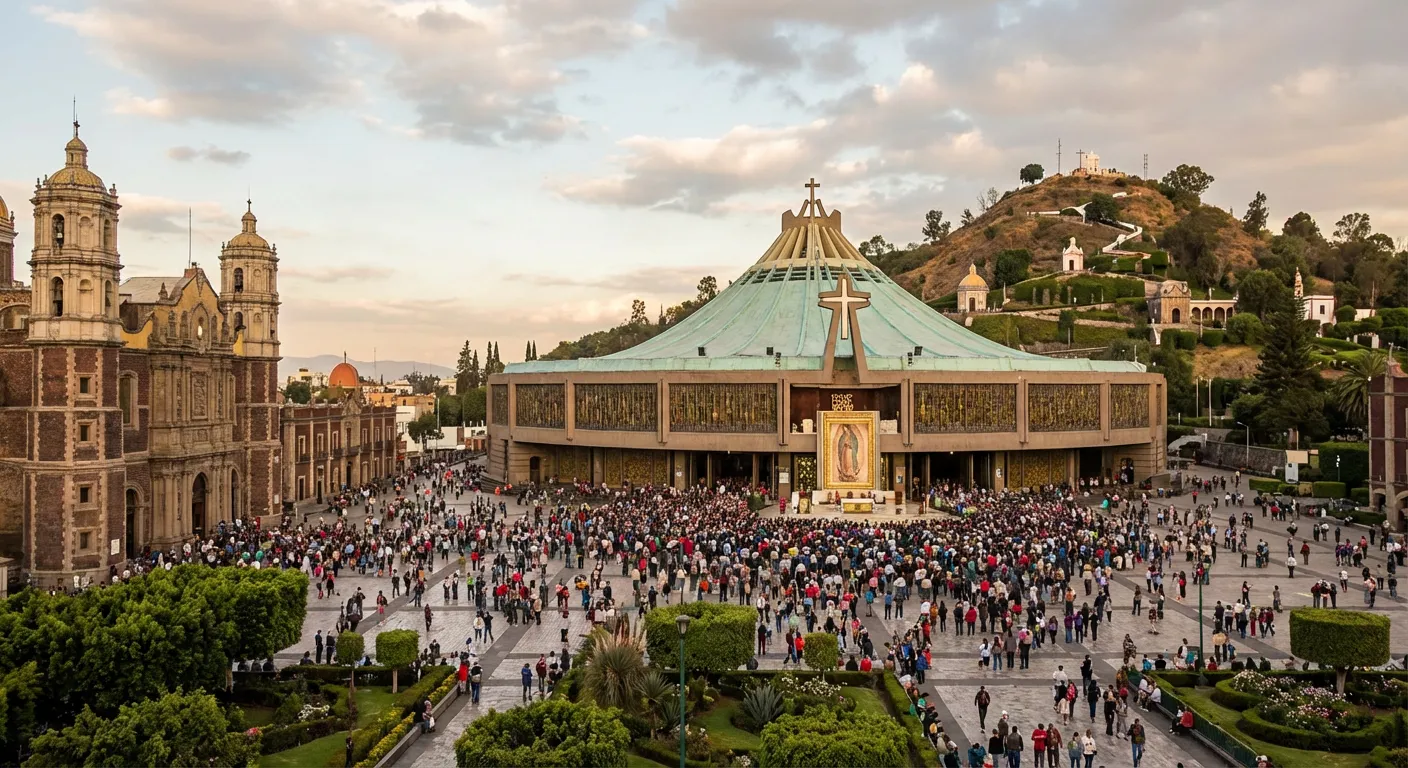
Our Lady of Guadalupe
In December 1531, on the slopes of Tepeyac Hill near present-day Mexico City, an indigenous peasant named St. Juan Diego experienced a profound heavenly encounter. While walking, he heard celestial music and saw a radiant woman bathed in golden light. Speaking to him gently in his native Nahuatl language, she identified herself as the Virgin Mary, the Mother of the true God. She entrusted Juan Diego with a vital mission: to approach the local bishop and request that a sacred shrine be built on that very spot. She promised that in this sanctuary, she would offer her compassionate love, hear the cries of the people, and heal their miseries, pains, and sorrows.
When the local bishop expressed skepticism and demanded a sign to prove the apparition's authenticity, the Virgin Mary provided a breathtaking miracle. She instructed Juan Diego to climb to the top of the barren, rocky hill and gather flowers. Despite it being the dead of winter, he miraculously found blooming Castilian roses, which he carefully gathered in his tilma, a traditional woven peasant cloak. Upon returning to the bishop, Juan Diego unfurled his cloak to present the flowers. As the roses cascaded to the floor, an awe-inspiring image of the Virgin Mary appeared perfectly imprinted on the coarse fabric of the tilma, leaving the bishop and all present on their knees in reverence.
This Vatican-approved apparition profoundly altered the spiritual landscape of the Americas. The miraculous image seamlessly blended indigenous and European Christian symbolism, which sparked the mass conversion of millions of native people to the Catholic faith and helped bridge a deep cultural divide. Today, St. Juan Diego's original tilma remains inexplicably preserved and is displayed at the Basilica of Our Lady of Guadalupe in Mexico City. As the Patroness of the Americas, Our Lady of Guadalupe continues to draw tens of millions of pilgrims each year, standing as an enduring symbol of maternal protection, unity, and unwavering faith.
20000000