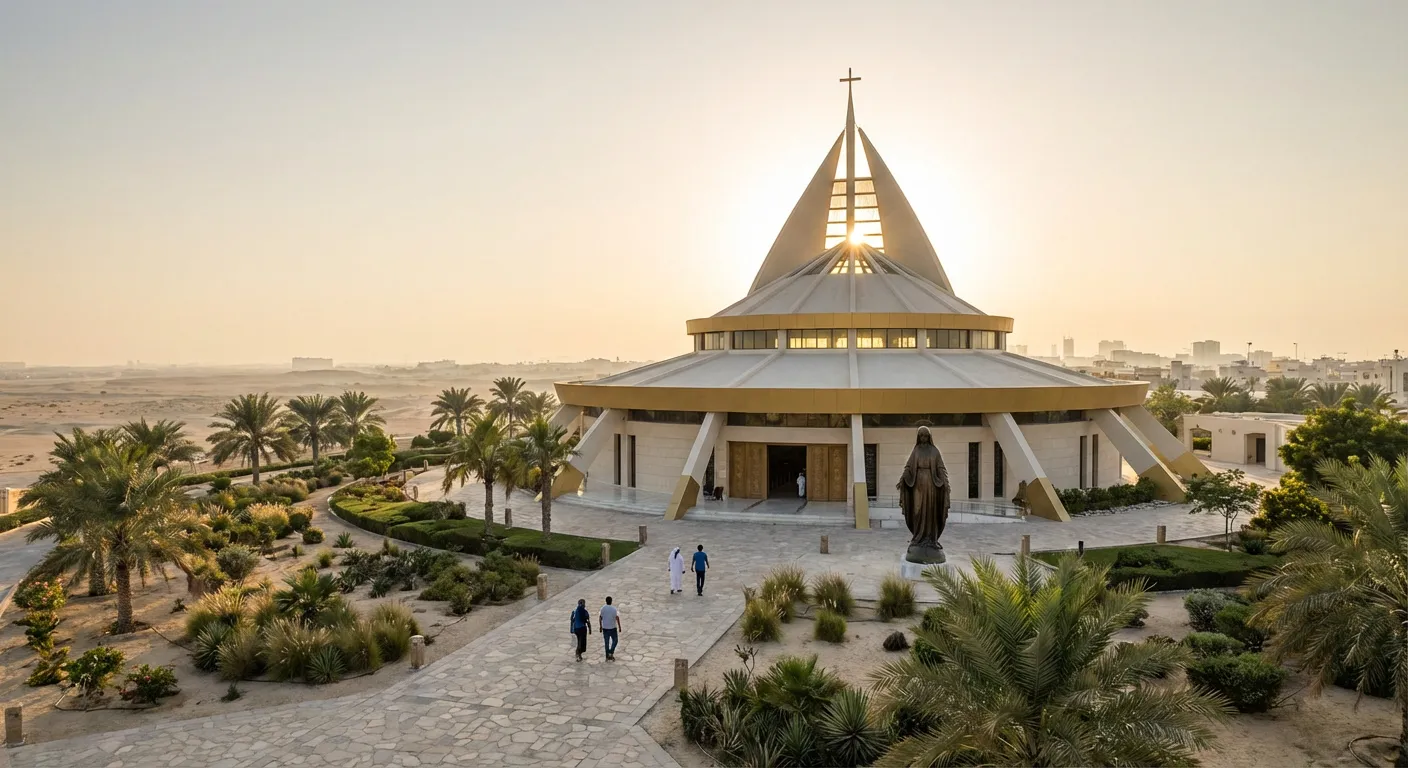
Our Lady of Arabia
Based on the historical and religious records regarding Our Lady of Arabia, it is important to clarify that the details provided for Awali, Bahrain, in 2021 do not refer to a Marian apparition. There were no supernatural visions, spoken messages from the Virgin Mary, or visionaries involved. Instead, the year 2021 marks a historic and monumental event for the Catholic Church in the region: the consecration of the Cathedral of Our Lady of Arabia. Bishop Paul Hinder was not a visionary, but rather the Apostolic Administrator of Northern Arabia who played a key leadership role in the completion and inauguration of this significant church.
The title "Our Lady of Arabia" actually originated as a devotion rather than an apparition. It began in 1948 in Ahmadi, Kuwait, when Father Teofano Ubaldo Stella sought to unite the diverse, multinational community of Catholic migrant workers under a single patroness. A statue of Mary holding the Christ Child was enshrined, and the devotion grew so profoundly among the faithful that Pope Pius XII formally authorized the title in 1957. While there were no miraculous signs in the traditional sense of an apparition, the faithful consider the enduring strength, unity, and survival of the Christian community in the Arabian Peninsula to be a miracle of grace in itself.
The events of 2021 in Awali represent the culmination of this decades-long devotion. The Cathedral of Our Lady of Arabia, built on land generously donated by the King of Bahrain, stands as a modern symbol of interfaith coexistence and religious freedom. When it was consecrated, it became the largest Catholic church in the Arabian Peninsula. For the millions of Catholic migrants living in the region, the cathedral serves as a profound spiritual home. The lasting impact of Our Lady of Arabia is seen not through an apparition, but through the tangible, growing presence of a unified faithful community finding sanctuary and hope in their new cathedral.
100000